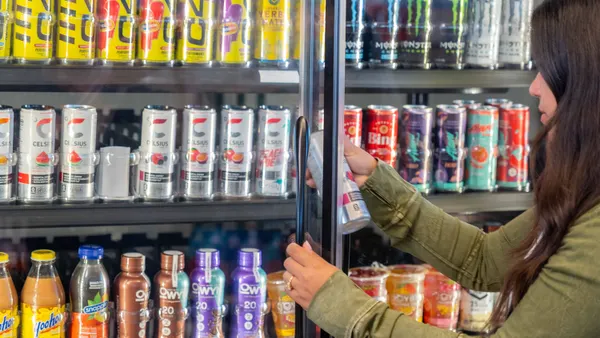
Casey’s General Stores recently highlighted energy drinks as a big part of its 4% same-store sales boost in the retailer’s fiscal third quarter. And the Iowa-based company isn’t the only convenience retailer enjoying the financial benefits of the booming category.
With overall sales of $24.8 billion for the year that ended on March 7, energy drinks made up the second-largest slice of the nonalcoholic packaged beverage pie in that time, according to a report from Goldman Sachs, citing NielsenIQ data. They trail only regular carbonated beverages, which saw sales of over $30 billion for the same span.
Energy drinks are the second-biggest packaged beverage category
While carbonated beverages like Coke and Mountain Dew still lead in sales, growth in the category was largely flat, according to the data. Bottled water also saw less than a 1% increase in sales, while sports drink sales pulled back slightly.
The biggest increase in nonalcoholic packaged beverages has come from energy drinks, which saw sales grow almost 14% year over year in the 52 weeks that ended March 7. That slightly outpaced low-calorie sodas, which saw sales rise 11% in the same span.
The growth in energy drinks is supported by five of the largest brands in the category, which saw 52-week sales growth on both a one-year and two-year basis, according to the Goldman Sachs report.
The 5 top energy drink companies see year-over-year growth
Since the top five companies make up over 90% of energy drink sales, according to the Goldman Sachs report, they steer how the whole category performs.
The growing attention on energy drinks comes as caffeine becomes an increasingly vital aid for many people trying to keep up with their lives and work.
“Consumers are looking for ways to boost their energy and alertness across the day,” said Sally Lyons Wyatt, global executive vice president and chief advisor of consumer goods and foodservice insights for Circana, in an earlier interview. “There is a need due to sleep, stress, and schedule fragmentation.”
Breaking down shifts in the energy drink category
Not all brands are performing at the same level. Looking closer at Monster Energy, which owns the largest dollar share of this category, some of its brands saw vastly different results during the 52 weeks that ended March 7.
Monster saw its biggest growth among several namesake brands — Monster Ultra, Juice Monster, Monster Zero Sugar and Monster Ultra Vice Guava.
Monster Energy saw growth, but many of its brands contracted
Its non-Monster brands, however, saw mixed year-over-year results. Reign, which the company debuted in 2019, saw sales drop 7.1%, while the better-for-you spinoff Reign Storm was down 4%. Sales for Reign Inferno, which the company calls “thermogenic fuel,” declined nearly 50%.
Bang, the brand Monster bought in 2023, lost over 4%.
On the other side, NOS managed slight sales gains year over year, while Full Throttle was up almost 3%.
Second place producer Red Bull doesn’t have multiple brands to break down, but among its various flavors and styles, Red Bull Zero saw the most growth at nearly 200%. While that’s not surprising considering the zero-sugar drinks only went into wide release in January 2025, the growth of low-calorie soda suggests low-calorie drinks are worth watching.
With Celsius, which saw the biggest year-over-year sales growth among the top producers, we also see split fortunes.
Alani Nu brings the bulk of Celsius Holdings’ growth
In 2025, Celsius picked up fast-growing Alani Nu, a brand which nearly doubled its sales year over year to roughly $1.6 billion.
Celsius’ namesake brand saw close to 9% sales growth over that same span, with flavors like orange, sparkling grape rush and peach mango green tea seeing some of the biggest gains among top performers.
Sales for the company’s Rockstar brand, meanwhile, lost 7% year over year.
The biggest sales gains among smaller producers came from N.A. Coffee Partnership, a collaboration between Starbucks and PepsiCo that primarily sells Starbucks-themed energy beverages. G Fuel also recorded growth, though its gains were much smaller at 1.2%.
Familiar brands see sales drop while PepsiCo and Starbucks partnership booms
Most of the smaller players saw pullback, however. PepsiCo, which offers several varieties of Mountain Dew-based energy drinks, like Amp and Kickstart, was down almost 28% year over year to $130 million for the 52 weeks that ended March 7.
In that same span, Prime energy drinks, which went viral in 2022 and 2023, saw sales fall nearly 65%, while A Shoc Beverage, maker of Accelerator drinks, saw sales fall by over 45%. Ferolito, Vultaggio & Sons, which makes Arizona-themed energy drinks, saw a smaller sales drop of around 3%.